
Alternative to Meds Editorial Team
Medically Reviewed by Dr John Motl MD
Table of Contents:
- Video: The Truth About Seroquel
- Can You Become Addicted to Seroquel?
- What is Seroquel and What is it Used For?
- Why Some People Struggle to Stop Taking Seroquel
- Withdrawal and Discontinuation Symptoms
- Alternatives and Supportive Approaches
- Lifestyle and Nutritional Support
- Holistic Therapies
- Medical and Integrative Alternatives
- When to Seek Professional Help
- Final Thoughts: Safe Recovery and Long-term Balance
However, psychological factors that need addressing can vary widely. But in either scenario the discontinuation process must be extremely slow, and does better with holistic supports in place. Read on for more information on the best strategies to implement.
Overcoming Seroquel Addiction and Dependence
Can You Become Addicted to Seroquel?
The DSM 5 has provided a nuanced way to understand addiction as a spectrum, rather than a yes/no issue. For a medication that was prescribed to help a person manage unwanted symptoms, the term addiction may not be appropriate for some.1,8
The term used to describe when a drug causes withdrawal symptoms when it is discontinued is medication dependence. And Seroquel is such a medication.
So, is Seroquel addictive? Yes, there have been cases where Seroquel was used in ways that could be described as stemming from addiction to Seroquel, including recreational, off-label, or other examples of misuse of the drug. In the main, though, Seroquel dependence is an expected presentation even after using it as prescribed, which is usually over a significant time period. When the drug is discontinued, withdrawal symptoms will present.
What is Seroquel and What is it Used For?
 Seroquel, or generic quetiapine, is classed as an atypical antipsychotic medication. The FDA-approved uses are in the treatment of schizophrenia symptoms, bipolar, and major depressive disorders.2
Off-label uses have increased significantly, accounting for about 20% of all prescriptions. In Norway, off-label prescriptions of Seroquel far outweigh approved uses. But few of these applications have been backed up by randomized, double blind clinical trials. Often, a small study with insufficient evidence encourages off-label use for a particular symptom or result, and follow-up trials were typically not done to confirm efficacy. This trend has continued for over 25 years resulting in more prescriptions being written for non-approved uses.3-5,8
These off-label uses have included insomnia, anxiety, the treatment of substance abuse, and many others which remain unspecified, apart from the fact that Seroquel was not dispensed for an approved use. Researchers voice concerns that the rise in off-label use may contribute to the likelihood of cases of abuse, profound side effects, and toxicity.
Why Some People Struggle to Stop Taking Seroquel
Some people report a level of psychological comfort from the sedative effects of Seroquel. But when they stop taking it, withdrawals present such as difficulty sleeping, increased anxiety and agitation, and other unwanted symptoms.
For some, the discontinuation may feel like a relapse of the original condition when it could well be the withdrawal syndrome associated with stopping Seroquel. Seroquel withdrawal syndrome suffers from a lack of clinical studies, but according to the WHO, Seroquel is particularly difficult compared to other antipsychotic medications to come off of without suffering significant withdrawals. These are discussed in more detail below.7
Withdrawal and Discontinuation Symptoms
 Although the clinical data is sparse on the subject of Seroquel withdrawal, there are clinical studies and case reports that have reported the most common symptoms when coming off this drug. It is important to seek medical oversight when coming off a powerful drug such as Seroquel or other antipsychotic medications, regardless of why the drug was prescribed in the first place.6
Antipsychotics typically suppress dopamine expression, which creates what is called dopamine upregulation. In this dopamine-starved condition, the dopamine receptors become “hungrier” for dopamine. So when Seroquel is stopped, dopamine expression becomes super activated and can result in psychosis, abnormal behaviors, insomnia, or other significant withdrawal manifestations.
But as the name “Seroquel” suggests, this drug also is thought to act on serotonin expression as well. How exactly it does so is not known, but is suggested to dampen emotions, and outside stimulations. This is shown in the fact that on the street, Seroquel is referred to as “baby heroin” for its similar effects.8
More information on safely tapering from Seroquel is recommended reading, and should provide talking points to discuss with your professional caregivers.
Common Seroquel withdrawal symptoms can include:
- Insomnia
- Nausea, vomiting
- Heightened anxiety
- Restlessness
- Irritability
- Dizziness
An important and sometimes overlooked factor is managing the dopaminergic surge that occurs in Seroquel withdrawal. Learn about strategies to avoid the consequences of too much dopamine expression and how to avoid overstimulation during an antipsychotic taper process. These can be found described in more detail below.12
Alternatives and Supportive Approaches
Antipsychotic tapering needs to be very, very slow and gradual. Supportive approaches in Seroquel withdrawal are recommended to keep the taper process progressing smoothly. Below are some types of holistic supports that can be extremely beneficial in softening the taper process.
Lifestyle and Nutritional Support
It is not recommended to start a Seroquel taper if you are not sleeping well, and not eating well. Get these areas working well so that these do not act as barriers to your success.10,11
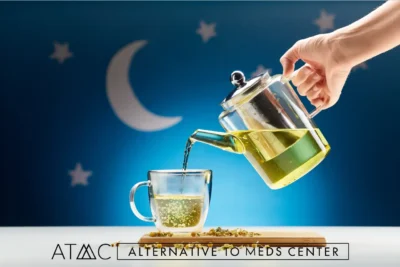 Actions that can be helpful here are to manage sleep with a consistent bedtime routine, and making the sleeping area more conducive to quality sleep. Make sure you have a comfortable mattress and dust-free linens. Consider blackout curtains, eye masks, and it is highly recommended to take the electronics out of the bedroom. Keep the area free from outside noise or disturbances. Supplements can also help with relaxation and mood stability such as magnesium, and omega-3s, and amino acids, from either supplements or food sources. Teas can provide calming effects before retiring such as chamomile, peppermint, and other herbal teas. Avoid teas with caffeine such as matcha or black tea. 15
Try to eat 4-6 small meals over the day, rather than heavy meals at any one time to keep blood sugar levels evened out. Avoid sugary foods and refined carbs, and a ketogenic diet is highly recommended.
Avoid anything with caffeine such as coffee or energy drinks, because of their stimulating effects.
Recreational use of marijuana or stimulants of any kind should also be strictly avoided as these can contribute to what is known as drug-induced psychosis.
Utilizing strategies such as these can help ensure the taper is a success.
Holistic Therapies
There are a number of supportive tools that can be employed in the process of coming off Seroquel successfully. CBT (cognitive behavioral therapy) can be tailored to your exact situation. Acupuncture, therapeutic massage, practicing mindfulness, yoga, Qigong, and meditation are all holistic therapies worth investing time in.9,13,14
Medical and Integrative Alternatives
Functional medicine, and integrative medicine are 2 branches of medical support that are well-equipped to help a person come off antipsychotic medication safely. These will be outpatient-style facilities that adhere to holistic principals, and able to provide safe guidelines for your taper.
It is sometimes easier to deal with the process inpatient, where medical staff, personal therapists, and personal care staff can be present for you 24/7. This is a more stress-free approach and may be appropriate where symptoms are tending to be severe.
When to Seek Professional Help
Anyone tapering off antipsychotic medications is advised to seek medical oversight to help guide the process. Some persons will try to taper too quickly unless proper medical oversight is there to discourage it. Coming off antipsychotic medications like Seroquel too quickly can be disastrous.
Take the safest approach, and if during the outpatient taper process symptoms begin to become unmanageable, seek medical help immediately. For example, if a person suddenly becomes hyper-focused on religious matters, or suddenly begins unusual or even dangerous behaviors, stops sleeping, or stops eating, these can be signs that the taper is progressing much too quickly and needs to be brought back down to a manageable level. Otherwise, hospitalization may be the safest next step.
Final Thoughts: Safe Recovery and Long-Term Balance
Becoming dependent on Seroquel isn’t a sign of failure. It is probably the default outcome for the majority of people who take this medication over a significant period of time. Becoming dependent on a drug may take quite a while to manifest, and similarly, it may take a significant period of time for recovery. The delicate neurotransmitters and receptors in the brain and CNS need time to adapt to the absence of the medication. The body needs the proper raw materials to repair any neuronal damage and stabilize once again.
Becoming dependent on Seroquel, and similarly, becoming addicted to any substance can be resolved if the proper supports are in place. Learn as much as you can about gradual tapering and why its necessary. Seek guidance on how to introduce lifestyle changes and natural therapies into your regular routines to attain the successful outcome you desire.
Contact ATMC for assistance with Seroquel
Sources:
1. Grant JE, Chamberlain SR. Expanding the definition of addiction: DSM-5 vs. ICD-11. CNS Spectr. 2016 Aug;21(4):300-3. doi: 10.1017/S1092852916000183. Epub 2016 May 6. PMID: 27151528; PMCID: PMC5328289.[cited 2026 Jan 9]
2. FDA drug label Seroquel (quetiapine fumerate) tablets approval 1997 [cited 2026 Jan 9]
3. Grabitz P, Saksone L, Schorr SG, Schwietering J, Bittlinger M, Kimmelman J. Research encouraging off-label use of quetiapine: A systematic meta-epidemiological analysis. Clin Trials. 2024 Aug;21(4):418-429. doi: 10.1177/17407745231225470. Epub 2024 Jan 29. PMID: 38284364. [cited 2026 Jan 9]
4. Citrome L, Kalsekar I, Guo Z, Laubmeier K, Hebden T. Diagnoses associated with use of atypical antipsychotics in a commercial health plan: a claims database analysis. Clin Ther. 2013 Dec;35(12):1867-75. doi: 10.1016/j.clinthera.2013.09.006. Epub 2013 Oct 8. PMID: 24119767. [cited 2026 Jan 9]
5. Gjerden P, Bramness JG, Tvete IF, Slørdal L. The antipsychotic agent quetiapine is increasingly not used as such: dispensed prescriptions in Norway 2004-2015. Eur J Clin Pharmacol. 2017 Sep;73(9):1173-1179. doi: 10.1007/s00228-017-2281-8. Epub 2017 Jun 16. PMID: 28623386.[cited 2026 Jan 9]
6. Monahan K, Cuzens-Sutton J, Siskind D, Kisely S. Quetiapine withdrawal: A systematic review. Aust N Z J Psychiatry. 2021 Aug;55(8):772-783. doi: 10.1177/0004867420965693. Epub 2020 Oct 16. PMID: 33059460. [cited 2026 Jan 9]
7. Storck W, de Laportalière TT, Yrondi A, Javelot H, Berna F, Montastruc F. Withdrawal syndrome after antipsychotics discontinuation: an analysis of the WHO database of spontaneous reports (Vigibase) between 2000 and 2022. Psychopharmacology (Berl). 2024 Jun;241(6):1205-1212. doi: 10.1007/s00213-024-06554-4. Epub 2024 Feb 20. PMID: 38376511. [cited 2026 Jan 9]
8. Sansone RA, Sansone LA. Is seroquel developing an illicit reputation for misuse/abuse? Psychiatry (Edgmont). 2010 Jan;7(1):13-6. PMID: 20386631; PMCID: PMC2848462. [cited 2026 Jan 9]
9. Lee MY, Lee BH, Kim HY, Yang CH. Bidirectional role of acupuncture in the treatment of drug addiction. Neurosci Biobehav Rev. 2021 Jul;126:382-397. doi: 10.1016/j.neubiorev.2021.04.004. Epub 2021 Apr 8. PMID: 33839169.[cited 2026 Jan 9]
10. Sarnyai Z, Kraeuter AK, Palmer CM. Ketogenic diet for schizophrenia: clinical implication. Curr Opin Psychiatry. 2019 Sep;32(5):394-401. doi: 10.1097/YCO.0000000000000535. PMID: 31192814. [cited 2026 Jan 9]
11. Valentina Baldini, Francesco Pasquino, Diana De Ronchi, Giuseppe Plazzi, Lorenzo Pelizza, Marco Menchetti, Sleep disturbances in individuals with first episode psychosis and clinical high-risk states: A systematic review, Schizophrenia Research, Abstract available online) Volume 282, 2025, Pages 123-132, ISSN 0920-9964, https://doi.org/10.1016/j.schres.2025.06.008. [cited 2026 Jan 9 ]
12. Chouinard G, Samaha AN, Chouinard VA, Peretti CS, Kanahara N, Takase M, Iyo M. Antipsychotic-Induced Dopamine Supersensitivity Psychosis: Pharmacology, Criteria, and Therapy. Psychother Psychosom. 2017;86(4):189-219. doi: 10.1159/000477313. Epub 2017 Jun 24. PMID: 28647739. [cited 2026 Jan 9 ]
13. Cooper RE, Ashman M, Lomani J, Moncrieff J, Guy A, Davies J, Morant N, Horowitz M. “Stabilise-reduce, stabilise-reduce”: A survey of the common practices of deprescribing services and recommendations for future services. PLoS One. 2023 Mar 15;18(3):e0282988. doi: 10.1371/journal.pone.0282988. PMID: 36920968; PMCID: PMC10016688. [cited 2026 Jan 9 ]
14.Garland EL, Froeliger B, Howard MO. Mindfulness training targets neurocognitive mechanisms of addiction at the attention-appraisal-emotion interface. Front Psychiatry. 2014 Jan 10;4:173. doi: 10.3389/fpsyt.2013.00173. PMID: 24454293; PMCID: PMC3887509. [cited 2026 Jan 9 ]
15. Ziyi Han, Leyu Wang, Huanqing Zhu, Youying Tu, Puming He, Bo Li,
Uncovering the effects and mechanisms of tea and its components on depression, anxiety, and sleep disorders: A comprehensive review, Food Research International,
Volume 197, Part 1, 2024, 115191, ISSN 0963-9969, [cited 2026 Jan 9 ]
Originally Published January 9, 2026 by Diane Ridaeus
Dr. John Motl, M.D.
Dr. Motl is currently certified by the American Board of Psychiatry and Neurology in Psychiatry, and Board eligible in Neurology and licensed in the state of Arizona. He holds a Bachelor of Science degree with a major in biology and minors in chemistry and philosophy. He graduated from Creighton University School of Medicine with a Doctor of Medicine. Dr. Motl has studied Medical Acupuncture at the Colorado School of Traditional Chinese Medicine and at U.C.L.A.
Social Profile: LinkedIn
Diane is an avid supporter and researcher of natural mental health strategies. Diane received her medical writing and science communication certification through Stanford University and has published over 3 million words on the topics of holistic health, addiction, recovery, and alternative medicine. She has proudly worked with the Alternative to Meds Center since its inception and is grateful for the opportunity to help the founding members develop this world-class center that has helped so many thousands regain natural mental health.