Last Updated on September 16, 2026 by
Alternative to Meds Editorial Team
Medically Reviewed by ATMC Clinical Review Team
Table of Contents:
Additionally, some non-pharmacological alternatives to benzodiazepines will be covered to discuss with your caregiver that could be well worth exploring. For managing blood pressure-related symptoms, there are also alternatives to consider. Read on to learn more.
Are there Natural Approaches to Manage Blood Pressure?
Will Ativan Lower Blood Pressure?
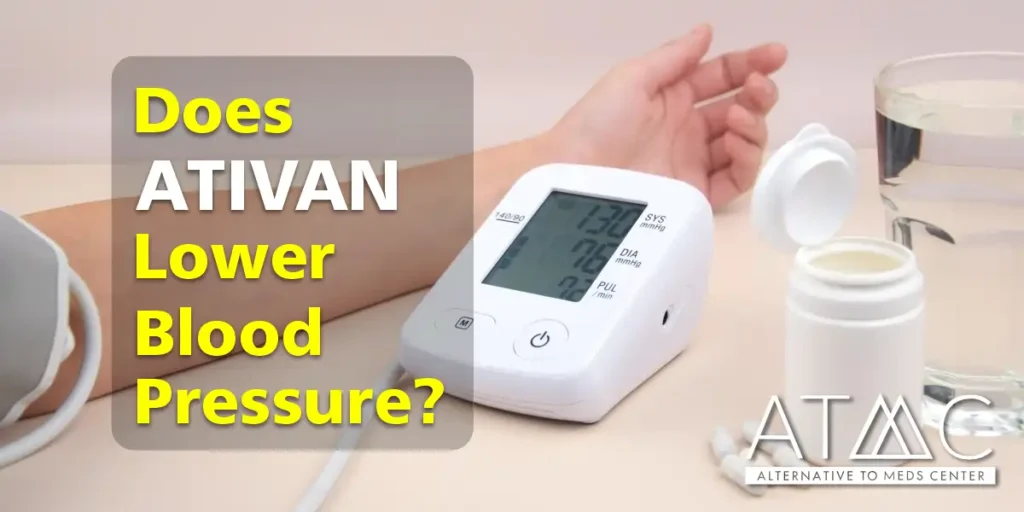
Ativan is a benzodiazepine that induces short-term calming and sedating effects for conditions such as anxiety or panic attacks. Ativan is useful as a short-term aid in a wide range of medical uses. However, used long-term, this calming effect may potentially influence blood pressure. The effect on blood pressure is typically slight and usually temporary. When it occurs In older persons, or in cases of polypharmacy or long-term use, these effects may be more risky.
Blood pressure is measured in various ways, typically by using the “cuff” method, to gauge the pressure against blood vessel walls. A measurement of between 90 and 120 is considered to be normal. This measurement is of the pumping action of the heart which is referred to as the systolic measurement. A systolic measurement lower than 90 is considered low blood pressure or hypotension. Low blood pressure or hypotension tends to be neglected as a topic of concern. Mostly one hears about high blood pressure, (hypertension), as it is associated with many other non-optimum health conditions. Both hypotension (low blood pressure) and hypertension (high blood pressure) may go undiagnosed as there may be minimal to no noticeable symptoms.
 However, some persons with low blood pressure may often feel dizziness, lightheadedness, and fatigue. A person with hypotension may experience such symptoms chronically, and others may experience a sudden drop in blood pressure, below 90 on the blood pressure scale. This is called orthostatic hypotension which typically occurs after standing for a long time, or when rising from a seated or lying position. Orthostatic hypotension happens suddenly and can make you feel faint, like you may pass out, can cause blurred vision, can cause dizziness or a spinning sensation.
Benzodiazepines can slow the heart rate, respiration rate, and relax the central nervous system. and this can temporarily lower blood pressure slightly. However, if one’s blood pressure is already in a low range, this may be a health concern to speak with your prescriber or caregiver about. Often, low blood pressure is undiagnosed. Fortunately, it may be easily checked.
Understanding How Ativan Works in the Body
Ativan is also used to quickly tranquilize an agitated person, used before surgery as a sedative, in acute alcohol withdrawal, in treating pre-chemotherapy associated nausea, insomnia, and is used in many other off label purposes.
Benzodiazepines cause respiratory depression, and when taken at high dosages, or in combination with other depressants such as opioids, kratom, or alcohol, the results can be catastrophic leading to coma and even death.
Benzodiazepines also may cause slurred speech, induce drowsiness, and can affect many other functions relating to the central nervous system. Below you will find a more complete description of how Ativan can affect different areas of the body.
Common Side Effects of Ativan
A person taking Ativan may experience mild to more severe side effects and these can differ greatly from person to person. In addition to sedation, there can be paradoxical side effects which can have unexpected stimulatory effects.4-6
These are commonly reported side effects of Ativan:
- Sedation
- Slowed breathing
- Muscle relaxation
- Dizziness
- Physical weakness, asthenia
- Inability to control muscles, clumsiness, ataxia
- Hypotension
- Tiredness, fatigue
- Amnesia
- Confusion
- Irritability, unusual emotional mood swings
- Sexual dysfunction
- Menstrual irregularities
- Double vision, burred vision
- Slurred speech
- Hoarseness
- Appetite changes
- Constipation
- Incontinence
- Urinary retention
More severe side effects of Ativan which are less common can include:
- Suicidality
- Respiratory failure
- Seizures
- Abnormal changes in behavior
- Impaired cognitive function, most notably in the elderly
- Memory loss
- Respiratory failure
- Tolerance, dependency and potential for abuse
- Withdrawals when the medication is stopped
- Involuntary muscle movements, dystonia
- Fainting, orthostatic hypotension after rising from a seated or laying position
- Changes in white or red blood cells
- Liver damage, jaundice
- Paradoxical reaction s(hyperactive and aggressive behavior, agitation, heightened anxiety, racing heart beat at rest)
- When combined with other CNS depressants such as opioids, coma or death
- Cognitive decline, delirium, psychosis
- Cardiac impairment
- Abnormal metabolism of fat
Does Ativan Cause Low Blood Pressure?
So is there a connection between taking Ativan and low blood pressure? While more research is called for, a note of caution is worth mentioning here, particularly in the elderly. In this population, and in other at-risk persons, benzodiazepines like Ativan can contribute to orthostatic hypotension. As a result, this population may experience more falls, due to symptoms like dizziness and loss of balance. When a person is taking other medications such as Ativan, that depress the central nervous system these drops in blood pressure, and other symptoms related to low blood pressure can be more pronounced, and more frequent.
It is important to note that in general, people with low blood pressure do not experience symptoms unless there is such a decrease in the pumping action of the heart, and insufficient circulation, that the blood cannot reach the vital organs that need it.1,2,3
When to Speak to a Health Care Professional
If you are experiencing ongoing problems like dizziness, feeling lightheaded, blurred vision or other symptoms it is time to seek a healthcare provider who can test for hypotension or rule it out.
If you are currently taking Ativan or any benzodiazepine, and are experiencing symptoms that fit the description of hypotension, do not stop taking Ativan abruptly, Seek guidance from your medical care professionals, who can help determine whether it is recommended to slowly taper off Ativan or other recommendations to help resolve the situation.
Researchers have discovered some non-drug-based strategies have proven helpful in reducing orthostatic hypotension, thus preventing unnecessary falls or other outcomes without additional drug side effects. Exercise, sleeping position, dietary changes, and other interventions have shown promise in clinical trials. 9
Safer Alternatives for Managing Anxiety
 Alternative to Meds Center offers effective and safe holistic treatment options for anxiety, as well as safe and gradual benzodiazepine tapering. Using orthomolecular and naturopathic support for medication withdrawal, the process is gentle and avoids the typically intolerable nature of benzodiazepine discontinuation.
Much research backs the holistic approach to managing and reducing symptoms of anxiety, pointing to cognitive behavioral and other genres of counseling, exercise, herbal and nutritional applications, and many others that do not carry the same risks and side effects associated with medication-based approaches.7,8
We would encourage you to read further about the specific treatment programs and strategies that are used at the center to help those who are looking for safer alternatives to Ativan, or other anti-anxiety treatment options that do not rely on medication for results.
for Help with Alternatives to Ativan
Sources:
1. Rivasi G, Kenny RA, Ungar A, Romero-Ortuno R. Effects of benzodiazepines on orthostatic blood pressure in older people. Eur J Intern Med. 2020 Feb;72:73-78. doi: 10.1016/j.ejim.2019.10.032. Epub 2019 Nov 6. PMID: 31706708. [cited 2026 Jan 6]
2. Chen RJ, Sharma S, Bhattacharya PT. Hypotension. 2025 May 3. In: StatPearls [Internet]. Treasure Island (FL): StatPearls Publishing; 2025 Jan–. PMID: 29763136.[cited 2026 Jan 6]
3. Solanki B, Goel R, Gupta LK. Benzodiazepines Reduce Blood Pressure in Short Term: A Systematic Review and Meta-analysis – PubMed. Curr Hypertens Rep. 2023 Oct;25(10):335-341. doi: 10.1007/s11906-023-01256-2. Epub 2023 Aug 15. PMID: 37581768.[cited 2026 Jan 6]
4. Ghiasi N, Bhansali RK, Marwaha R. Lorazepam. [Updated 2024 May 25]. In: StatPearls [Internet]. Treasure Island (FL): StatPearls Publishing; 2025 Jan-. Available from: https://www.ncbi.nlm.nih.gov/books/NBK532890/[cited 2026 Jan 6]
5. Su Z, Huang Z, Chen X, Li X. Adverse event profile of lorazepam: a real-world pharmacovigilance study using the FDA adverse event reporting system database. Front Pharmacol. 2024 Nov 22;15:1465245. doi: 10.3389/fphar.2024.1465245. PMID: 3965
6. FDA label Ativan (lorazepam) tablets revised 02/2021 [cited 2026 Jan 6]
7. Hofmann SG, Asnaani A, Vonk IJ, Sawyer AT, Fang A. The Efficacy of Cognitive Behavioral Therapy: A Review of Meta-analyses. Cognit Ther Res. 2012 Oct 1;36(5):427-440. doi: 10.1007/s10608-012-9476-1. Epub 2012 Jul 31. PMID: 23459093; PMCID: PMC3584580. [cited 2026 Jan 6]
8. Hofmann SG, Gómez AF. Mindfulness-Based Interventions for Anxiety and Depression. Psychiatr Clin North Am. 2017 Dec;40(4):739-749. doi: 10.1016/j.psc.2017.08.008. Epub 2017 Sep 18. PMID: 29080597; PMCID: PMC5679245. [cited 2026 Jan 6]
8. Logan A, Freeman J, Pooler J, Kent B, Gunn H, Billings S, Cork E, Marsden J. Effectiveness of non-pharmacological interventions to treat orthostatic hypotension in elderly people and people with a neurological condition: a systematic review. JBI Evid Synth. 2020 Dec;18(12):2556-2617. doi: 10.11124/JBISRIR-D-18-00005. PMID: 32773495. [cited 2026 Jan 6]
Originally Published January 7, 2025 by Diane Ridaeus

ATMC Clinical Review Team
The ATMC Clinical Review Team includes licensed physicians and experienced healthcare professionals dedicated to ensuring the accuracy, quality, and integrity of our medical content. The team reviews articles for clinical accuracy, evidence-based guidance, and relevance while supporting Alternative to Meds Center’s whole-person approach to mental health, recovery, and long-term wellness.

Diane is an avid supporter and researcher of natural mental health strategies. Diane received her medical writing and science communication certification through Stanford University and has published over 3 million words on the topics of holistic health, addiction, recovery, and alternative medicine. She has proudly worked with the Alternative to Meds Center since its inception and is grateful for the opportunity to help the founding members develop this world-class center that has helped so many thousands regain natural mental health.