Alternative to Meds Editorial Team
Medically Reviewed by ATMC Clinical Review Team
Table of Contents:
- Video: The Mental Wellness Diet That Can Change Your Life
- Is ATMC Evidence-Based? How Our Holistic Approach is Rooted in Science
- Cognitive Behavioral Therapy
- Eye-Movement Desensitization & Reprocessing Therapy
- Sauna Therapy
- Orthomolecular & Naturopathic Medicine
- Video: What is Orthomolecular Psychiatry?
- Nutritional Psychiatry
- Credentials that Inspire Confidence
- Proven Outcomes, Evidence-Based, and Backed by Data
- Holistic ≠ Unscientific at ATMC
- Find Out More about ATMC’s Evidence-Backed Treatment Programs
Everyone’s journey to mental wellness is unique, but without these two elements, the road for most can be torturously long, and the destination elusive. At ATMC, the staff is dedicated to these and other powerful catalysts that help our clients reach their goals with confidence.
Our passion is helping clients find freedom from medication and reclaim mental wellness using a model grounded in science, driven by outcomes, and delivered by professionals for over 17 years.
Is ATMC Evidence-Based? How Our Holistic Approach is Rooted in Science
Here is a brief summary of some of the protocols used at ATMC, followed by an expanded description of each of the items below.
Examples of evidence-based protocols used in treatment include:
- Cognitive Behavioral Therapy (CBT)
- Eye-movement Desensitization & Reprocessing (EMDR)
- Sauna Therapy
- Orthomolecular and Naturopathic Medicine
- Nutritional Psychiatry
Cognitive Behavioral Therapy
CBT has long been heralded as a gold standard in treating mood and thought disorders. A characteristic of CBT that is widely recognized is its protective effect against symptom relapse long after the therapy has concluded, which is not an attribute of medication-based therapy.1
CBT is delivered in a one-on-one counseling session with a licensed therapist who guides the participant in reviewing old, destructive, or self-sabotaging patterns of thought and behavior, and creating new, practical strategies that serve to enhance one’s day-to-day life, relationships, goals, and more.
CBT and “mindfulness-based” cognitive therapies can be helpful for all age groups, and can be adapted successfully to address a very long list of disorders, situations, and conditions, including ADHD symptoms, major depressive disorders, panic and anxiety-related conditions, insomnia, and many others.2,-4
Eye-Movement Desensitization & Reprocessing Therapy
EMDR is a relatively new and extensively researched therapy developed in 1995. In clinical trials and studies, EMDR demonstrated significant efficacy in the reduction of PTSD, anxiety, depression, and other stress- and trauma-based conditions of distress.
EMDR is a drug-free form of one-on-one psychotherapy, the goal of which is to untangle trauma or emotional memories using bilateral taps, or tones, to isolate and desensitize their lingering, disturbing effects. EMDR has been shown to be effective across different cultures, and has a very wide range of application.5.14
Sauna Therapy
Sauna therapy, a form of whole-body thermotherapy, has been around for thousands of years. Its popularity is no surprise due to its efficiency in detoxification, hygiene, relaxation, improved circulation, and improving mood and sleep. Intermittent cooling-off periods and exercise are utilized along with frequent rehydration with water to ensure maximum health benefits.
 One of the advantages of sauna detoxification is that the toxins, such as mercury, cadmium, lead, arsenic, etc., can escape through the sweat, which eliminates the burden of stress on the liver, because the liver is not needed in the elimination process.7
Carefully conducted clinical trials have shown improvements in both healthy persons, and in patients with severe cardiac disease, where benefits such as reduction in over-sized heart, longer walking times, decreased muscle stiffness and decreased heart pain levels were documented.6
For chronic headache sufferers, this population saw a 44% reduction in headache intensity over a 6-week sauna program. Some other improvements noted were decreased fatigue, less anxiety & depression, and improved quality of life. For COPD (chronic lung disease) patients, the ability and duration of exercise were improved, along with a reduction in congestion and other related symptoms.
And some of the most exciting evidence-based clinical reports showed that the vast majority of depression sufferers reported their symptoms diminished, and continued to be reduced at 40 months follow-up, after their sauna treatment.
Orthomolecular and Naturopathic Medicine
The term “orthomolecular” medicine was coined by 2-time Nobel Prize winner Linus Pauling. Dr. Pauling’s groundbreaking research has changed much in the field of understanding nutrition’s role in medicine over the past decades.
Naturopathy is the study and application of the body’s own natural healing pathways and the discoveries of holistic protocols that support natural health and healing.
Nutritional Psychiatry
Nutritional psychiatry is an emerging field with strong data connecting diet, gut health, and mental wellness. The effects of nutrition on wellness, both physical and mental, have been rigorously studied in many settings for many decades. Nutrition as therapy is informed by over a century of clinical testing and close observation, resulting in an enormous body of practical and highly useful knowledge.12,13
Treatment Credentials that Inspire Confidence
- Psychiatric Nurse Practitioners (PMHNPs) oversee medication tapering and psychiatric care
- Licensed Therapists (LPCs, LCPCs, LCSWs, LMSWs, LCPs, LNAs) provide psychotherapy, trauma counseling, behavioral support, Addiction and SUD recovery, massage therapy, acupuncture, and many other functions.
- Registered Nurses (RNs) assist with daily care and monitoring
- Licensed Naturopathic// Medical Physicians, Nutritional Psychiatrists (NMDs, NPs, MDs) guide holistic assessments, and natural treatment protocols
Proven Outcomes, Evidence-Based, and Backed by Data
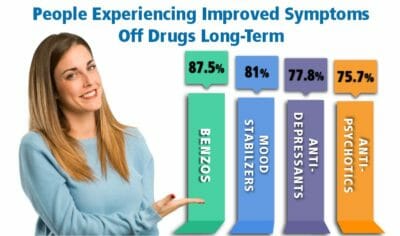
We don’t just believe in our results, we track them. In our outcome study, 77% of participants experienced improvement in symptoms like anxiety, depression, insomnia, and others after completing our program. Clients typically reported improved energy, quality of sleep, reduced medication reliance, and increased overall well-being. These reports weren’t anecdotal; they were measurable and consistent across our participant base. These are evidence-based outcomes and bring hope to clients, many of whom have been subjected to guesswork and experimental treatments that failed. Today, there is hope, compassion, and confidence in your recovery at ATMC.
Holistic ≠ Unscientific at ATMC
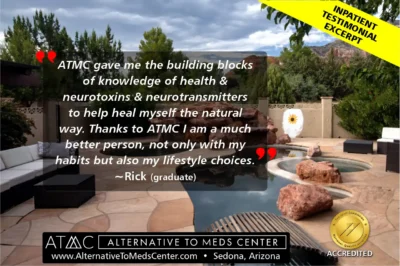 At ATMC, holistic does NOT mean unscientific — it means comprehensive. We treat the whole person, not just the symptoms. That includes exploring root causes like toxicity, nutrient depletion, gut health, and trauma — areas often overlooked in traditional psychiatry.
We deliver a wealth of services to our clients, and each program is designed uniquely and with care for the individual.
The integrative lens is fully supported by modern research in nutritional psychiatry, functional medicine, neurobiology, and psychoneuroimmunology — fields that continue to provide evidence for the connection between mind, body, and environment.
Find Out More About ATMC’s Evidence-Backed Treatment Programs
You are invited to call or email us at any time for more info and to get your questions answered about the treatment programs we offer. We can also help you find out about insurance coverage, costs, length of stay, and other questions. Our philosophy at ATMC is unique and can be life-changing.
You may wish to take a closer look at the facility in Sedona, AZ, and our staff.
We are here to assist you on your journey to wellness and natural mental health.
Contact us for more on evidence-based treatment at ATMC
Sources:
1. Driessen E, Hollon SD. Cognitive behavioral therapy for mood disorders: efficacy, moderators and mediators. Psychiatr Clin North Am. 2010 Sep;33(3):537-55. doi: 10.1016/j.psc.2010.04.005. PMID: 20599132; PMCID: PMC2933381. [cited 2025 June 4]
2. Zhang Z, Zhang L, Zhang G, Jin J, Zheng Z. The effect of CBT and its modifications for relapse prevention in major depressive disorder: a systematic review and meta-analysis. BMC Psychiatry. 2018 Feb 23;18(1):50. doi: 10.1186/s12888-018-1610-5. PMID: 29475431; PMCID: PMC6389220.[cited 2025 June 4]
3. Auclair V, Harvey PO, Lepage M. La thérapie cognitive-comportementale dans le traitement du TDAH chez l’adulte [Cognitive Behavioral Therapy and the Treatment of ADHD in Adults]. Sante Ment Que. 2016 Spring;41(1):291-311. French. PMID: 27570962.[cited 2025 June 4]
4. Curtiss JE, Levine DS, Ander I, Baker AW. Cognitive-Behavioral Treatments for Anxiety and Stress-Related Disorders. Focus (Am Psychiatr Publ). 2021 Jun;19(2):184-189. doi:panic 10.1176/appi.focus.20200045. Epub 2021 Jun 17. PMID: 34690581; PMCID: PMC8475916.[cited 2025 June 4]
5. Wilson G, Farrell D, Barron I, Hutchins J, Whybrow D, Kiernan MD. The Use of Eye-Movement Desensitization Reprocessing (EMDR) Therapy in Treating Post-traumatic Stress Disorder-A Systematic Narrative Review. Front Psychol. 2018 Jun 6;9:923. doi: 10.3389/fpsyg.2018.00923. PMID: 29928250; PMCID: PMC5997931.[cited 2025 June 4]
6. Hussain J, Cohen M. Clinical Effects of Regular Dry Sauna Bathing: A Systematic Review. Evid Based Complement Alternat Med. 2018 Apr 24;2018:1857413. doi: 10.1155/2018/1857413. PMID: 29849692; PMCID: PMC5941775.[cited 2025 June 4]
7. Sears ME, Kerr KJ, Bray RI. Arsenic, cadmium, lead, and mercury in sweat: a systematic review. J Environ Public Health. 2012;2012:184745. doi: 10.1155/2012/184745. Epub 2012 Feb 22. PMID: 22505948; PMCID: PMC3312275.[cited 2025 June 4]
8. Zell M, Grundmann O. An orthomolecular approach to the prevention and treatment of psychiatric disorders. Adv Mind Body Med. 2012 Fall;26(2):14-28. PMID: 23341413.[cited 2025 June 4]
9. Carter S. Orthomolecular Medicine. Integr Med (Encinitas). 2019 Jun;18(3):74. PMID: 32549818; PMCID: PMC7217400.[cited 2025 June 4]
10. The Nobel Prized Linus Pauling The Facts, 1954, 1962 [cited 2025 June 4]
11. Litchy AP. Naturopathic physicians: holistic primary care and integrative medicine specialists. J Diet Suppl. 2011 Dec;8(4):369-77. doi: 10.3109/19390211.2011.623148. PMID: 22432775. [cited 2025 June 4]
12. Marx W, Moseley G, Berk M, Jacka F. Nutritional psychiatry: the present state of the evidence. Proceedings of the Nutrition Society. 2017;76(4):427-436. doi:10.1017/S0029665117002026 [cited 2025 June 4]
13. Borrego-Ruiz A, Borrego JJ. Nutritional Psychiatry: A Novel Approach to the Treatment of Mental Health Disorders. Actas Esp Psiquiatr. 2025 Mar;53(2):443-445. doi: 10.62641/aep.v53i2.1920. PMID: 40071358; PMCID: PMC11898261. [cited 2025 June 4]
14. Trauma Therapist Institute Demystifying EMDR: How This Therapy Works and What it Looks Like published online Feb 03, 2025 [cited 2025 June 4]
Originally Published June 4, 2025 by Diane Ridaeus
ATMC Clinical Review Team
The ATMC Clinical Review Team includes licensed physicians and experienced healthcare professionals dedicated to ensuring the accuracy, quality, and integrity of our medical content. The team reviews articles for clinical accuracy, evidence-based guidance, and relevance while supporting Alternative to Meds Center’s whole-person approach to mental health, recovery, and long-term wellness.

Diane is an avid supporter and researcher of natural mental health strategies. Diane received her medical writing and science communication certification through Stanford University and has published over 3 million words on the topics of holistic health, addiction, recovery, and alternative medicine. She has proudly worked with the Alternative to Meds Center since its inception and is grateful for the opportunity to help the founding members develop this world-class center that has helped so many thousands regain natural mental health.