Alternative to Meds Editorial Team
Medically Reviewed by Dr John Motl MD
Table of Contents:
- Video: What is Neurotoxicity?
- Multiple Strategies to Treat SUD, Addiction, Dependence
- What is SUD? Defining Substance Use Disorder
- Additional Insights
- Basics in Treating SUD, Addiction, Dependence
- Recreational Drugs and SUD
- Problematic Symptoms Can Lead to SUD
- Substance Use Disorder FAQs
- ATMC Provides Highly Personalized Care & Holistic Treatment for SUD in Sedona
Alternative to Meds Center (ATMC) recognizes each person has a unique history & neurochemical profile. Therefore, the approach to undoing these chains is best if precisely individualized. This has been our quest for the last nearly 20 years at ATMC, with great success.
We treat the person, not the label.
]
Multiple Strategies to Treat Substance Use Disorder
In the not too distant past, treatment options for SUD were limited to pharmacological interventions, abstinence and perhaps AA or NA meetings and 12-step programs for support. It’s only in the recent past that the term “disorder” attached itself to the treatment of addiction or dependence. A parallel was drawn between addiction & the disease model of treatment, and the quest to find the right “medicine” was launched. Tragically, many cases of SUD only occurred after prescription drugs were introduced to mask the very symptoms which remain unaddressed. The drug treatment community is still learning about how drugs of all kinds adversely affect our biochemistry.
Today there are many exciting, new strategies that have found their place in the treatment zone for addiction and dependence and recovery from SUD and healing from the past assaults of drug & alcohol addiction and dependence. ATMC uses a vast number of holistic and medically monitored protocols for recovery.
Treatments for SUD, addiction, and dependence can include:
 Medication-assisted interventions (see more details below)
- Safe drug withdrawal and gentle tapering
- CBT and other forms of psychological support 9
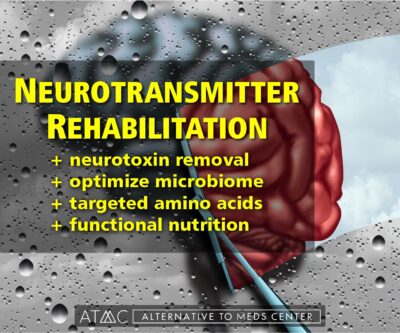
- Neurotransmitter rehabilitation
- Neurotoxin removal
- Addressing the gut microbiome 10,11
- Physical comfort therapies
- Physical exercise 13
- Nutritional support informed by lab testing 12,14,15,18
- Peer group support programs
- Non-pharmacological interventions for underlying symptoms such as insomnia, depression, anxiety, by discovering and addressing their root causes 13,17,18
What is SUD? Defining Substance Use Disorder
Terms can be tricky to define. Different camps have attempted to answer “What is SUD?”.
One might also ask:
- What are the symptoms of SUD?
- Is it a disease, like something you can catch?
- Is it incurable?
- Can medicine fix it?
The APA textbooks used by psychologists describe SUD as a complex cluster of symptoms. Paralleling the disease-model, in addiction treatment, terms are borrowed like “symptoms” and “disorders”. But unlike typical diseases, medicine cannot provide a cure. There are physical, social and spiritual components that must be included in the healing process because excessive and even daily substance use can lead to addiction and dependence.
 AMA texts used by the medical doctors of today use SUD, or substance use disorder, as a nonjudgmental term, officially mandating the replacement of other words like addiction, or addict or alcoholic- terms which are now declared to be racially or socially inappropriate.
The CDC defines SUD as a treatable chronic disease. Their 2023 survey reported 1 in 6 Americans experienced “an SUD” in that year, recommending medication as treatment to help with cravings and withdrawal. The CDC primarily subscribes to the “disease model” of addiction treatment.1-4
However, in the real world of simple observation, a drug used long enough can produce withdrawal symptoms when it is stopped. And whether called “addiction,” or “dependence,” or “a cluster of symptoms,” or a label such as SUD, such ongoing conditions can have disastrous consequences unless the means to safely stop using the drug are provided.
Our concentrated efforts at ATMC focus not on finding the correct label, or the correct medication to treat that label, but on discovering and relieving the things that are driving unchecked and destructive drug use. Our approach is to focus on holistic treatments. The label “SUD” becomes irrelevant in a holistic treatment context. What IS important, is understanding the causes of substance use disorder, addiction, and dependence and that can remove much confusion from the subject. And, these understandings can open the door to real healing.
Here are additional insights for you to review for a deeper dive into new research on holistic treatment for Substance Use Disorder, including addressing the mechanics of relapse.
Big Players in the SUD Industry
 There is no doubt that the some factions within the APA, the AMA, the FDA, and the drug industry appear to have formed something of a partnership, under the umbrella of SUD treatment.5 This relationship has fostered the approval of various medications within the disease model of addiction or SUD treatment.
In the lab, chemists can produce synthetic versions of opiates, or even a whole new chemical compound such as benzodiazepines that mimic, enhance, or inhibit hormonal & neurochemical actions and reactions in the human body. In this paradigm, any disorder including substance abuse disorder becomes a potential candidate for a chemical-based solution.
While the temporary use of certain drugs most certainly can assist in drug withdrawal, they also have addictive properties, and can develop undesirable side effects, especially if used long term. This greatly limits their practical usefulness.
In more mainstream rehab facilities, various prescription drugs have overshadowed drug-free treatment methods, not only to assist withdrawal, which is often necessary, but for long term treatment of substance use disorder.
Some of the drugs used as medicine to treat substance use disorders include:
- Methadone, Suboxone, Buprenorphine to treat opioid addiction or opioid use disorder
- Antabuse, baclofen, naltrexone, for alcohol addiction 20
- Stimulants such as modafinil, bupropion, for cocaine & methamphetamine addiction 6
- Bupropion (FDA approved use) for nicotine addiction 6
- Other antidepressant meds (off-label) for nicotine addiction such as nortriptyline7
- SSRIs for SUD 19
In contrast to this approach, ATMC uses drug-free alternatives wherever possible to aid and assist in SUD recovery. You can review these in our services overview section. When a person’s body becomes “un-poisoned” through authentic holistic detox methods, proper nutrition, and other means, the reasons one took drugs in the first place usually greatly lessen, or disappear altogether.
Basics in Treating Substance Use Disorder
In planning SUD treatment at ATMC, different classes of drugs require different approaches. Recovery after benzodiazepines and antipsychotics are some of the most frequently treated issues at ATMC.16.21 For specific drug classes, and detailed treatment protocols used at ATMC, you can review the following summaries:
Recreational Drugs and SUD
Recreational drugs are frequently used to combat one of the most under-studied triggers of drug and alcohol use: BOREDOM. Habitual use to combat symptoms like boredom, depression, anxiety, and others, can then evolve into devastating problems like SUD.
Holistic-based treatments provide a pathway back to creating inner joy and wellness that can supersede the need for chronic symptom relief or artificial stimuli.22
Tyler’s success story demonstrates his personal transformation at ATMC.
Problematic Symptoms Can Lead to Substance Use Disorder
SUD often develops from an ongoing need to get rid of unwanted symptoms. A person suffering from insomnia may seek medication to get a decent nights sleep. Commonly the medication stops working and sleeplessness returns. A person experiencing debilitating depression or anxiety may be prescribed medications that work only temporarily, and in many cases, introduce new troubling symptoms, followed by multiple prescriptions in a never-ending cycle.
Substance Use Disorder FAQs
While SUD is often referred to as a chronic condition, many individuals achieve long-term recovery through tailored treatment and lifestyle changes. The goal at ATMC is to go beyond symptom management and focus on sustainable healing and bio-transformation, specifically by rehabilitating normal neurotransmitter function.
ATMC Provides Highly Personalized Care & Holistic Treatment for SUD in Sedona
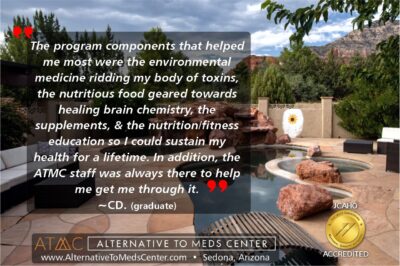 By investigating possible causes and contributors to these and other symptoms, we can begin to unravel the puzzle, and provide solutions that don’t rely on prescription medication for relief, and don’t further compromise a person’s health and well-being.
Your personal health history is unique to you … your SUD treatment plan also should be. Lab testing and other assessments are used in designing the program steps that will best help your recovery. We invite you to review the information on the website for a more detailed description of the many protocols used at the center in SUD recovery.
For further information about our approach to holistic treatment for SUD, addiction and dependence, please do not hesitate to reach out to us any time. We are here to help you or your loved one in your decision making process.
for Help with SUD Substance Use Disorder
Sources:
1. AMA American Medical Association Care for Substance Use Disorder, How-to Guide,Terminology published online (ND) [cited 2025 May 9]
2. APA Substance use, abuse, & addiction adapted from the APA Dictionary of Psychology, published 2025 [cited 2025 May 9]
3. Volkow ND, Blanco C. Substance use disorders: a comprehensive update of classification, epidemiology, neurobiology, clinical aspects, treatment and prevention. World Psychiatry. 2023 Jun;22(2):203-229. doi: 10.1002/wps.21073. PMID: 37159360; PMCID: PMC10168177. [cited 2025 May 9]
4. CDC What is an SUD? published online April 25, 2024 [cited 2025 May 9]
5. Halloran EC. Sickening: How Big Pharma Broke American Health Care and How We Can Repair It. Fam Med. 2023 Feb 21;55(3):207–8. doi: 10.22454/FamMed.2023.648056. PMCID: PMC10622007. [cited 2025 May 9]
6. Elkashef AM, Rawson RA, Anderson AL, Li SH, Holmes T, Smith EV, Chiang N, Kahn R, Vocci F, Ling W, Pearce VJ, McCann M, Campbell J, Gorodetzky C, Haning W, Carlton B, Mawhinney J, Weis D. Bupropion for the treatment of methamphetamine dependence. Neuropsychopharmacology. 2008 Apr;33(5):1162-70. doi: 10.1038/sj.npp.1301481. Epub 2007 Jun 20. PMID: 17581531. [cited 2025 May 9]
7. Merwar G, Gibbons JR, Hosseini SA, et al. Nortriptyline. [Updated 2023 Jun 5]. In: StatPearls [Internet]. Treasure Island (FL): StatPearls Publishing; 2025 Jan-. Available from: https://www.ncbi.nlm.nih.gov/books/NBK482214/ [cited 2025 May 9]
8. Lomas C. Neurobiology, psychotherapeutic interventions, and emerging therapies in addiction: a systematic review. J Addict Dis. 2024 Dec 17:1-19. doi: 10.1080/10550887.2024.2440184. Epub ahead of print. PMID: 39690473. [cited 2025 May 9]
9. Carroll KM, Kiluk BD. Cognitive behavioral interventions for alcohol and drug use disorders: Through the stage model and back again. Psychol Addict Behav. 2017 Dec;31(8):847-861. doi: 10.1037/adb0000311. Epub 2017 Aug 31. PMID: 28857574; PMCID: PMC5714654. [cited 2025 May 9]
10. Russell JT, Zhou Y, Weinstock GM, Bubier JA. The Gut Microbiome and Substance Use Disorder. Front Neurosci. 2021 Aug 31;15:725500. doi: 10.3389/fnins.2021.725500. PMID: 34531718; PMCID: PMC8439419. [cited 2025 May 9]
11. Wang SC, Chen YC, Chen SJ, Lee CH, Cheng CM. Alcohol Addiction, Gut Microbiota, and Alcoholism Treatment: A Review. Int J Mol Sci. 2020 Sep 3;21(17):6413. doi: 10.3390/ijms21176413. PMID: 32899236; PMCID: PMC7504034 [cited 2025 May 9]
12. Abbott L, Nadler J, Rude RK. Magnesium deficiency in alcoholism: possible contribution to osteoporosis and cardiovascular disease in alcoholics. Alcohol Clin Exp Res. 1994 Oct;18(5):1076-82. doi: 10.1111/j.1530-0277.1994.tb00084.x. PMID: 7847587. [cited 2025 May 9]
13. Wang D, Wang Y, Wang Y, Li R, Zhou C. Impact of physical exercise on substance use disorders: a meta-analysis. PLoS One. 2014 Oct 16;9(10):e110728. doi: 10.1371/journal.pone.0110728. PMID: 25330437; PMCID: PMC4199732. [cited 2025 May 9]
14. Brown JS Jr. Psychiatric issues in toxic exposures. Psychiatr Clin North Am. 2007 Dec;30(4):837-54. doi: 10.1016/j.psc.2007.07.004. PMID: 17938048. [cited 2025 May 9]
15. Sarris J, Ravindran A, Yatham LN, Marx W, Rucklidge JJ, McIntyre RS, Akhondzadeh S, Benedetti F, Caneo C, Cramer H, Cribb L, de Manincor M, Dean O, Deslandes AC, Freeman MP, Gangadhar B, Harvey BH, Kasper S, Lake J, Lopresti A, Lu L, Metri NJ, Mischoulon D, Ng CH, Nishi D, Rahimi R, Seedat S, Sinclair J, Su KP, Zhang ZJ, Berk M. Clinician guidelines for the treatment of psychiatric disorders with nutraceuticals and phytoceuticals: The World Federation of Societies of Biological Psychiatry (WFSBP) and Canadian Network for Mood and Anxiety Treatments (CANMAT) Taskforce. World J Biol Psychiatry. 2022 Jul;23(6):424-455. doi: 10.1080/15622975.2021.2013041. Epub 2022 Mar 21. PMID: 35311615. [cited 2025 May 9]
16. Ashton H. The diagnosis and management of benzodiazepine dependence. Curr Opin Psychiatry. 2005 May;18(3):249-55. doi: 10.1097/01.yco.0000165594.60434.84. PMID: 16639148. [cited 2025 May 9]
17. Del Rio Verduzco A, Salari A, Haghparast P. Efficacy and safety of pharmacotherapy in chronic insomnia: A review of clinical guidelines and case reports. Ment Health Clin. 2023 Oct 2;13(5):244-254. doi: 10.9740/mhc.2023.10.244. PMID: 38131058; PMCID: PMC10732122. [cited 2025 May 9]
18. Jeynes KD, Gibson EL. The importance of nutrition in aiding recovery from substance use disorders: A review. Drug Alcohol Depend. 2017 Oct 1;179:229-239. doi: 10.1016/j.drugalcdep.2017.07.006. Epub 2017 Aug 4. PMID: 28806640. [cited 2025 May 9]
19. Fluyau D, Mitra P, Jain A, Kailasam VK, Pierre CG. Selective serotonin reuptake inhibitors in the treatment of depression, anxiety, and post-traumatic stress disorder in substance use disorders: a Bayesian meta-analysis. Eur J Clin Pharmacol. 2022 Jun;78(6):931-942. doi: 10.1007/s00228-022-03303-4. Epub 2022 Mar 5. PMID: 35246699. [cited 2025 May 9]
20. Stokes M, Patel P, Abdijadid S. Disulfiram. [Updated 2024 Sep 10]. In: StatPearls [Internet]. Treasure Island (FL): StatPearls Publishing; 2025 Jan-. Available from: https://www.ncbi.nlm.nih.gov/books/NBK459340/ [cited 2025 May 9]
21. Lise M. Bjerre MD PhD CCFP Barbara Farrell PharmD ACPR FCSHP Matthew Hogel PhD Lyla Graham, et al, Deprescribing antipsychotics for behavioural and psychological symptoms of dementia and insomnia, [online PDF version] Canadian Family Physician Vol 64 January 2018 [cited 2025 May 9]
22. Freund VA, Schulenberg JE, Maslowsky J. Boredom by Sensation-Seeking Interactions During Adolescence: Associations with Substance Use, Externalizing Behavior, and Internalizing Symptoms in a US National Sample. Prev Sci. 2021 Jul;22(5):555-566. doi: 10.1007/s11121-020-01198-0. Epub 2021 Jan 29. PMID: 33512654; PMCID: PMC8981493. [cited 2025 May 9]
Originally Published May __, 2025 by Diane Ridaeus
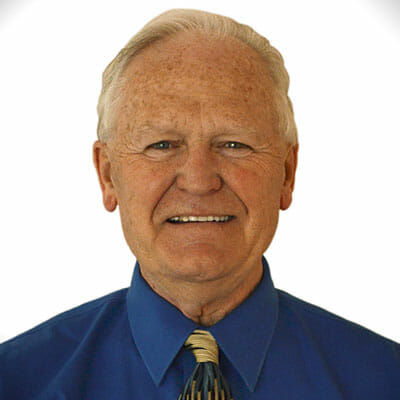
Dr. John Motl, M.D.
Dr. Motl is currently certified by the American Board of Psychiatry and Neurology in Psychiatry, and Board eligible in Neurology and licensed in the state of Arizona. He holds a Bachelor of Science degree with a major in biology and minors in chemistry and philosophy. He graduated from Creighton University School of Medicine with a Doctor of Medicine. Dr. Motl has studied Medical Acupuncture at the Colorado School of Traditional Chinese Medicine and at U.C.L.A.
Social Profile: LinkedIn
Diane is an avid supporter and researcher of natural mental health strategies. Diane received her medical writing and science communication certification through Stanford University and has published over 3 million words on the topics of holistic health, addiction, recovery, and alternative medicine. She has proudly worked with the Alternative to Meds Center since its inception and is grateful for the opportunity to help the founding members develop this world-class center that has helped so many thousands regain natural mental health.