What are Amino Acids?
 You could think of the body as a kind of kitchen, staffed with a highly trained chef, we’ll call Chef Pierre. And some very advanced culinary machines. Some system in the body sends an order to the “kitchen,” for example, it might need a certain ingredient at a specific time (like Chef Pierre needs almond flour to fill an order for some pastries perhaps). So he takes raw materials (the almonds), and breaks them down into their tiniest possible molecular form. In the case of amino acids, when we eat proteins, tiny molecular entities are formed consisting of 2 atoms of ammonia added to or replaced by 1 or more atoms of something else. These are exact recipes which appear to be stored somewhere in the human DNA.1,2,9,10
Then, Pierre, being a master chef, takes his almond flour (this pile of tiny molecular structures), and with his special recipe-to-order, and his specialized equipment, he mixes in some spices, and twists, shapes, folds, and re-folds these into perfect compound products. These compounds include the “amino acids”, enzymes, and other molecular ingredients, to make products like neurotransmitters and hormones. Amino acids are used as building blocks — molecules that bind, combine with other molecules, and each recipe produces a type of molecular entity that has one or more specific functions. These then get transported to wherever they are needed for multitudes of tasks.
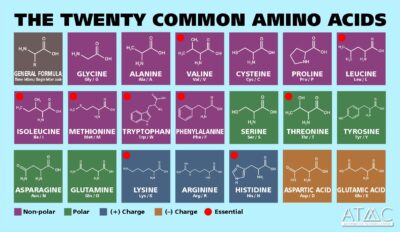
Proteins are sometimes referred to as the building blocks of life. Proteins are in every cell of the body. They are in plants, in animals, and in fact, in or on every living thing on the planet. When proteins are broken down, they are used to create hundreds of amino acids that we know of. But only a handful (about 20 or so) that are found in the human body. Amino acids help create our neurotransmitters, hormones, and other necessary compounds. These are the molecular “specialists” that help us maintain good health, both mental and physical.
There are 20 amino acids that have been found in the human body:
- Alanine
- Glycine
- Arginine
- Histidine
- Asparagine
- Isoleucine
- Cysteine
- Glutamic acid
- Glutamine
- Phenylalanine
- Tryptophan
- Methionine
- Aspartic acid
- Leucine
- Lysine
- Proline
- Tyrosine
- Serine
- Threonine
- Valine
What are “Essential” and “Non-essential” Amino Acids?
Some amino acids must be obtained from the foods we eat, or through supplementation. These are called “essential amino acids.” Essential here means we have to eat them to obtain them.
Essential amino acids include:
- Histidine
- Isoleucine
- Leucine
- Lysine
- Methionine
- Phenylalanine
- Threonine
- Tryptophan
- Valine
There are also what are called non-essential” amino acids. The term “non-essential” classification is perhaps a misleading one, as these are also indispensable for maintaining overall human health and mental wellness. Here, non-essential only means they don’t have to come from food — the body already has the innate capability to make them. Of course, this means the body already has the raw materials that are needed to create the needed amino acids for mental health.
In addition to the above lists, there are two newly discovered amino acids as well, namely selenocysteine and pyrrolysine. These 2 haven’t been classified yet as their biological pathways and functions are as yet not completely understood. Research is robust and on-going in the field of nutritional psychiatry, and according to researchers, the results so far are very practical and encouraging.
Research: Functions of Amino Acids for Mental Health

Suzuki et al’s fascinating study published in the 2020 Frontiers in Nutrition Journal compared the results of 50 participants being given a supplement of 7 powdered amino acids over 12 weeks, with the other 50 (placebo group) participants. Improvements were significant in the amino acid group for things like working memory, attention, executive function, emotional health, feeling of vitality, happiness, as well as decreased physical pain, decreased nervousness and decreased depressive symptoms were all noted.5
As far back as 2008, research published by Lakhan & Vieira on nutrition-based treatments for mental health disorders found that amino acids reliably reduce symptoms such as depression, concluding that amino acids are converted into neurotransmitters that can alleviate mental health symptoms. These researchers recommended amino acids (and other nutrients such as omega-3s, minerals and vitamins) as useful in the treatment of 4 specific disorders, namely major depressive disorder, schizophrenia, bipolar, and OCD. The researchers noted that these 4 conditions are often found correlated with such nutritional deficits and poor diet.6
Amino acids for mental health is an extensive subject of ongoing study. Vast tomes have been written explaining the intricate and fascinating molecular dance that occurs in the body. One key to understanding their function is that amino acids act as precursors — building blocks — that create other compounds and hormones. These biological pathways can be quite complex. For instance, in adults, tryptophan is a precursor to the hormone melatonin, which is a precursor to the neurotransmitter serotonin. Another example is that tyrosine can be synthesized from phenylalanine in adults, but not in children.
Food Sources & Supplements
Human health could be likened to a complex puzzle — if some nutritional pieces are missing, the result will be imperfect, and may develop into chronic dysfunction over time. Protein is the master nutrient for cells, skin, neurotransmission, and uncountable aspects of good human health. Where a habitually poor diet exists, amino acids and their compounds will be insufficient. In such cases, symptoms such as depression, anxiety, insomnia, fatigue and weakness can emerge. There are thousands of drugs on the market sold to people who suffer these symptoms. In fact, they may be suffering from malnourishment rather than a psychiatric disorder. This is an example of how amino acids for mental health would be able to rectify such symptoms in a natural, healing way. This would involve correction of the daily diet, and supplementation, to provide the missing nutrients.
You don’t need to eat ALL the amino acids at one sitting, or at every meal. Instead, adequate protein, as well as a varied diet is an efficient approach to making sure you are giving your body the entire range of these nutrients. Importantly, protein-rich foods are high on the list. If you consume beef, poultry, pork, seafood, eggs, cheese, tofu, nuts and seeds, a variety of fruits and vegetables, you are getting ALL 9 essential amino acids. Where possible, whole, organic, farm-fresh & unprocessed foods will get you the most bang for your buck when it comes to nutrition.
Good food choices for specific essential amino acids:
 Histidine – potatoes, rice, whole grains, cantaloupe, legumes
- Isoleucine – brown rice, lentils, beans, cabbage, organic soy, quinoa
- Leucine – seaweed, peas, pumpkin, sesame seeds
- Lysine – pistachios, beans, organic soy, quinoa
- Methionine – sunflower seeds, chia seeds, hemp seeds
- Phenylalanine – avocado, spirulina, pumpkin, oats, beans, rice, almonds
- Threonine – leafy greens, spirulina, watercress, chia seeds, hemp seeds
- Tryptophan – dairy products, turkey, spinach, sweet potatoes, spirulina
- Valine – broccoli, spinach, legumes, hemp seeds, chia seeds
Your health practitioner may recommend taking supplements if a deficiency is known or suspected. This can include essential and non-essential amino acids to support mental health. Amino acid preparations are easily available over-the-counter. But we recommend getting knowledgeable about what amino acids will be therapeutic for your particular situation before their use. Sometimes non-essential amino acids can become temporarily “essential” meaning that they need supplementation to correct a deficiency or to assist in treating an illness, muscle atrophy, or other interventions.11
How We Use Amino Acids for Mental Health at Alternative to Meds Center
We offer an extremely wide range of holistic services at the center. In the area of nutrition, amino acids for mental health is one of many powerful tools and can be helpful before, during and after medication withdrawal. Amino acids are part of the wider therapeutic use of nutrition that may help resolve troublesome symptoms that could have led to drug-taking in the first place.  However, neurotoxicity in the body can sabotage any use of nutrients or supplements, so neurotoxin removal should be done early in recovery. There can be many reasons for symptoms, so other things can be important to check as well, such as blood sugar-related issues, inability to digest protein, lack of exercise, and a whole range of important puzzle pieces. This is the holistic approach to wellness.
A cautionary note is important here for medication cessation and recovery. Work with a specialist who is trained in nutrition, is familiar with the various amino acids and their functions, as well as one who is well-versed in methods of medication-tapering. The choices for which amino acids, how much, and when to use them are best made by someone knowledgeable in all these areas, and is familiar with your unique profile, history, and your aims. We don’t recommend a shot-gun approach, but used correctly with guidance, amino acids for mental health in tandem with a complete nutrition overhaul could be one of the best strategies in your arsenal for healing and recovery.
Reach out to us for more information on the services we offer here at Alternative to Meds Center, including amino acids for mental health and how we blend these into a personalized inpatient program for your best pathway to full recovery.