Alternative to Meds Editorial Team
Medically Reviewed by Dr John Motl MD
Table of Contents:
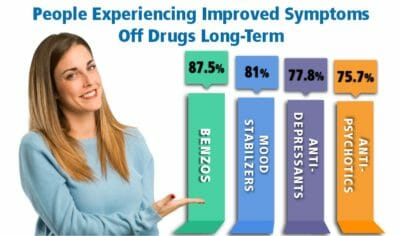
We help our clients achieve long-term success rates as high as 87.5%. Perhaps you have come to a point where you want to re-evaluate your treatment goals and come to understand…
It is possible to recover, and our world-class integrative psychiatry center was developed to get you back on the path to drug-free mental wellness.
Curious about the benefits of Integrative Psychiatry?
What can our integrative mental health facility offer?
Integrative mental health treatments are based on sound medical principles and also provide new approaches to improving mental health without drugs. Integrative medicine physicians do not specialize in trying to obfuscate the patient’s symptoms. What is important is discovering and then addressing the root causes of a person’s mental health symptoms. Instead of using drugs as a first-line choice, integrative physicians and integrative psychiatrists would only resort to a prescription if and when all else failed. This compassionate, client-based care provides a welcome breath of fresh air to everyone.
To be sure, there are drugs that can play an important role in medicine. But, drugs should NOT be the only item on the menu. Clearly, drug companies should NOT be allowed to pressure doctors to offer drugs as the very first choice to improve mental wellness in the vast majority of cases. There are an absolute plethora of non-drug-based treatments that are available within the setting of our cutting edge integrative mental health facility.1
Masking Symptoms vs Resolving Symptoms
Taking one’s car into a repair shop that didn’t even look under the hood, check the oil or other fluids, etc. would quickly gain that shop a bad reputation. That mechanic would go bankrupt pretty fast. Imagine telling the mechanic about your car’s symptoms, let’s say, a loud knocking noise. The mechanic smiles, nods knowingly. “That’s not at all uncommon,” he says, as he hands you a pair of earmuffs and the bill. “That should take care of that knocking sound.”
And, many doctor/patient conversations are about that brief before reaching for the prescription pad. But the doctors who practice such methods aren’t going bankrupt any time soon. Except, physicians, in the main, are going emotionally bankrupt. According to studies, US doctors are just as unhappy about the current state of medical practice as their patients are. Integrative medicine is probably the best answer to the medical-industrial complex that has turned the practice of healing into something some have described as grotesque and nearly unrecognizable.2
Integrative Mental Health Treatment at the Alternative to Meds Center
 Doctors who treat their patients with compassion, authentically caring, and using sound principles are often much happier than doctors who do not have that opportunity. Drugging mental health patients as the all-too-common type of therapy has shown a dismal outcome in the majority of cases. Illnesses and disorders do not get fixed. it is observable that this is the case.3-10
On the other hand, witnessing the great results from our doctors and caregivers at Alternative to Meds integrative mental health facility is an ongoing source of joy for everyone here at the facility. By the same token, when our clients are treated effectively, and with expertise and kindness, they experience true healing and wellness, sometimes for the first time in a very long time.
We invite you to contact us and get all your questions answered by a caring staff member who would be happy to speak with you today. Find out how our integrative mental health facility could provide exactly the kinds of help you or a loved one has been searching for.
for more about our Integrative Mental Health Facility
Sources:
1. Tanner LM, Wildman JM, Stoniute A, Still M, Bernard K, Green R, Eastaugh CH, Thomson KH, Sowden S. Non-pharmaceutical primary care interventions to improve mental health in deprived populations: a systematic review. Br J Gen Pract. 2023 Mar 30;73(729):e242-e248. doi: 10.3399/BJGP.2022.0343. PMID: 36997215; PMCID: PMC9926284. [cited 2026 April 21]
2. O Rourke M, Doctors Tell All – and it’s Bad. The Atlantic Magazine [INTERNET] 2014 Nov [cited 2026 April 21]
3. Collier R. Physician health: beyond wellness to happiness. CMAJ. 2017 Oct 2;189(39):E1242-E1243. doi: 10.1503/cmaj.1095499. PMID: 28970267; PMCID: PMC5628042. [cited 2026 April 21]
4. Safer DJ. Overprescribed Medications for US Adults: Four Major Examples. J Clin Med Res. 2019 Sep;11(9):617-622. doi: 10.14740/jocmr3906. Epub 2019 Sep 1. PMID: 31523334; PMCID: PMC6731049. [cited 2026 April 21]
5. Fried TR, Mecca MC. Medication Appropriateness in Vulnerable Older Adults: Healthy Skepticism of Appropriate Polypharmacy. J Am Geriatr Soc. 2019 Jun;67(6):1123-1127. doi: 10.1111/jgs.15798. Epub 2019 Jan 30. PMID: 30697698; PMCID: PMC6561813. [cited 2026 April 21]
6. Gøtzsche PC, Young AH, Crace J. Does long term use of psychiatric drugs cause more harm than good? BMJ. 2015 May 12;350:h2435. doi: 10.1136/bmj.h2435. PMID: 25985333; PMCID: PMC4707562. [cited 2026 April 21]
7. Tikkinen KAO, Rutanen J, Frances A, Perry BL, Dennis BB, Agarwal A, Maqbool A, Ebrahim S, Leinonen JS, Järvinen TLN, Guyatt GH. Public, health professional and legislator perspectives on the concept of psychiatric disease: a population-based survey. BMJ Open. 2019 Jun 4;9(6):e024265. doi: 10.1136/bmjopen-2018-024265. PMID: 31167856; PMCID: PMC6561450. [cited 2026 April 21]
8. Frances A. The past, present and future of psychiatric diagnosis. World Psychiatry. 2013 Jun;12(2):111-2. doi: 10.1002/wps.20027. PMID: 23737411; PMCID: PMC3683254. [cited 2026 April 21]
9. Zhang A, Franklin C, Jing S, Bornheimer LA, Hai AH, Himle JA, Kong D, Ji Q. The effectiveness of four empirically supported psychotherapies for primary care depression and anxiety: A systematic review and meta-analysis. J Affect Disord. 2019 Feb 15;245:1168-1186. doi: 10.1016/j.jad.2018.12.008. Epub 2018 Dec 11. PMID: 30699860. [cited 2026 April 21]
10. Bloch S, Green SA. An ethical framework for psychiatry. Br J Psychiatry. 2006 Jan;188:7-12. doi: 10.1192/bjp.188.1.7. PMID: 16388063. [cited 2026 April 21]
Originally Published Mar 26, 2020 by Diane Ridaeus
Dr. John Motl, M.D.
Dr. Motl is currently certified by the American Board of Psychiatry and Neurology in Psychiatry, and Board eligible in Neurology and licensed in the state of Arizona. He holds a Bachelor of Science degree with a major in biology and minors in chemistry and philosophy. He graduated from Creighton University School of Medicine with a Doctor of Medicine. Dr. Motl has studied Medical Acupuncture at the Colorado School of Traditional Chinese Medicine and at U.C.L.A.
Social Profile: LinkedIn
Diane is an avid supporter and researcher of natural mental health strategies. Diane received her medical writing and science communication certification through Stanford University and has published over 3 million words on the topics of holistic health, addiction, recovery, and alternative medicine. She has proudly worked with the Alternative to Meds Center since its inception and is grateful for the opportunity to help the founding members develop this world-class center that has helped so many thousands regain natural mental health.