Alternative to Meds Editorial Team
Medically Reviewed by Dr John Motl MD
Table of Contents:
Orthomolecular and environmental medicine are two of the main pillars in our recovery programs. The center’s approach to improving mental wellness is enriched by the use of acudetox both during the acute withdrawal phase of treatment, and as part of a comprehensive treatment plan used to accelerate healing well after drug cessation is complete.
What is Acudetox?
Acudetox is a word formed from combining “acupuncture” and “detox” and refers to a specific form of acupuncture treatment targeting the ear. This process has been found useful in detox, and in many other areas of human health.
Acudetox was first developed in the 1970s by a Hong Kong neurosurgeon, and has since became widely used in treating those withdrawing from drugs, alcohol, and medications.
Acudetox has also been found useful in many other areas including holistic relief from mental health symptoms and unwanted conditions such as insomnia, mood swings, and anxiety.
An especially interesting report describes over 20 clinical trials on depression, involving over 1300 participants, that suggest acupuncture to be more effective than drug-based therapy with fewer side effects, and fewer adverse outcomes, even when used as a stand-alone treatment intervention lasting only 4 weeks. That kind of evidence should not be ignored. 7
How is Acudetox Done?
Acudetox can be done in a group or individual setting and is delivered by a licensed therapist who has been trained in the process. The protocols used in acudetox are developed and overseen by NADA, the National Acupuncture Detoxification Association.2,3,6
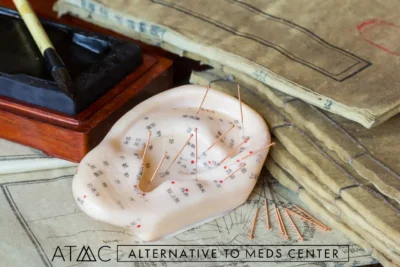 The process is simple, but effective. Very fine sterilized needles are inserted at 5 exact points of the outer ear. The needles will remain inserted until the end of the treatment, which runs about 30-45 minutes. The process is non-verbal, and some practitioners use calming background music for the client’s enhanced comfort. These 5 acupuncture contact points situated on the outer ear are described briefly below. The needles are inserted in both outer ears at these points.1,4,5
- Sympathetic nervous system
- Shen Men, a point in the upper part of the ear, which enables calmness, feelings of well-being, and relaxation
- Kidney
- Liver
- Lung
These 5 points produce changes by stimulating specific nervous system pathways, and are thought to trigger natural neurochemicals that can significantly ease the discomfort normally associated with drug or alcohol withdrawal. Additionally, a reduction in drug and alcohol cravings has been reported in the clinical findings where acudetox was used to support the detox process.
Acupuncture Mental Health Benefits Reported in Clinical Research
Acupuncture has been observed in clinical trials to provide certain mental health benefits, with no reported side effects. Most find the initial sting of the needle being inserted a mild sensation that lasts only briefly.
Mental health benefits reported include the following:
- Decreased anxiety
- Improved depression scores, fewer side effects compared to drug-based treatment
- Reduced nausea
- Less irritability
- Immediate relief from physical discomfort
- Reduction in emotional mood swings
- Significant improvements in sleep duration and quality
How Does Acudetox Help in Drug Withdrawal?
Acupuncture has been used to decrease mental health symptoms associated with drug or alcohol withdrawal. But also has been used to relieve physical pain and discomfort frequently associated with stopping drugs or alcohol. Additionally, the pain-relieving characteristics of acupuncture can reduce the ongoing cravings and compulsions associated with the continued use of substances especially where they are used to relieve physical pain.5-7
Acudetox is not meant to be a stand-alone treatment for addiction or recovery, but as a support it lends great value to a comprehensive program that can undo drug damage and allow a person to find health, peace and happiness without continuing to rely on drugs for relief.
Suggested further reading:
• Acupuncture for Medication Withdrawal and Addiction Recovery
• The Benefits of Acupuncture for Depression and Mental Health
Sources:
1. Kitzman JM, Bowman LC, Lin YC. Acupuncture in Addiction Medicine: Its History, Evidence, and Possibilities. Med Acupunct. 2023 Jun 1;35(3):111-116. doi: 10.1089/acu.2023.0021. Epub 2023 Jun 15. PMID: 37361008; PMCID: PMC10282830.[cited 2026 Jan 22]
2. Stuyt EB, Voyles CA. The National Acupuncture Detoxification Association protocol, auricular acupuncture to support patients with substance abuse and behavioral health disorders: current perspectives. Subst Abuse Rehabil. 2016 Dec 7;7:169-180. doi: 10.2147/SAR.S99161. PMID: 27994492; PMCID: PMC5153313.[cited 2026 Jan 22]
3. Carter K, Olshan-Perlmutter M. NADA protocol: integrative acupuncture in addictions. J Addict Nurs. 2014 Oct-Dec;25(4):182-7; quiz 188-9. doi: 10.1097/JAN.0000000000000045. Erratum in: J Addict Nurs. 2015 Jan-Mar;26(1):52. doi: 10.1097/jan.0000000000000069. PMID: 25514687.[cited 2026 Jan 22]
4. Ahlberg R, Skårberg K, Brus O, Kjellin L. Auricular acupuncture for substance use: a randomized controlled trial of effects on anxiety, sleep, drug use and use of addiction treatment services. Subst Abuse Treat Prev Policy. 2016 Jul 25;11(1):24. doi: 10.1186/s13011-016-0068-z. PMID: 27451854; PMCID: PMC4959048.[cited 2026 Jan 22]
5. Yin X, Gou M, Xu J, Dong B, Yin P, Masquelin F, Wu J, Lao L, Xu S. Efficacy and safety of acupuncture treatment on primary insomnia: a randomized controlled trial. Sleep Med. 2017 Sep;37:193-200. doi: 10.1016/j.sleep.2017.02.012. Epub 2017 Mar 8. PMID: 28899535.[cited 2026 Jan 22]
6. Carter K, Olshan-Perlmutter M, Marx J, Martini JF, Cairns SB. NADA Ear Acupuncture: An Adjunctive Therapy to Improve and Maintain Positive Outcomes in Substance Abuse Treatment. Behav Sci (Basel). 2017 Jun 16;7(2):37. doi: 10.3390/bs7020037. PMID: 28621706; PMCID: PMC5485467.[cited 2026 Jan 22]
7. Tan Y, Duan R, Wen C. Efficacy of acupuncture for depression: a systematic review and meta-analysis. Front Neurosci. 2024 Apr 30;18:1347651. doi: 10.3389/fnins.2024.1347651. PMID: 38745939; PMCID: PMC11091333.[cited 2026 Jan 22]
Originally Published January 23, 2026 by Diane Ridaeus

Dr. John Motl, M.D.
Dr. Motl is currently certified by the American Board of Psychiatry and Neurology in Psychiatry, and Board eligible in Neurology and licensed in the state of Arizona. He holds a Bachelor of Science degree with a major in biology and minors in chemistry and philosophy. He graduated from Creighton University School of Medicine with a Doctor of Medicine. Dr. Motl has studied Medical Acupuncture at the Colorado School of Traditional Chinese Medicine and at U.C.L.A.